
The Listening Skill Even Experienced Communicators Miss

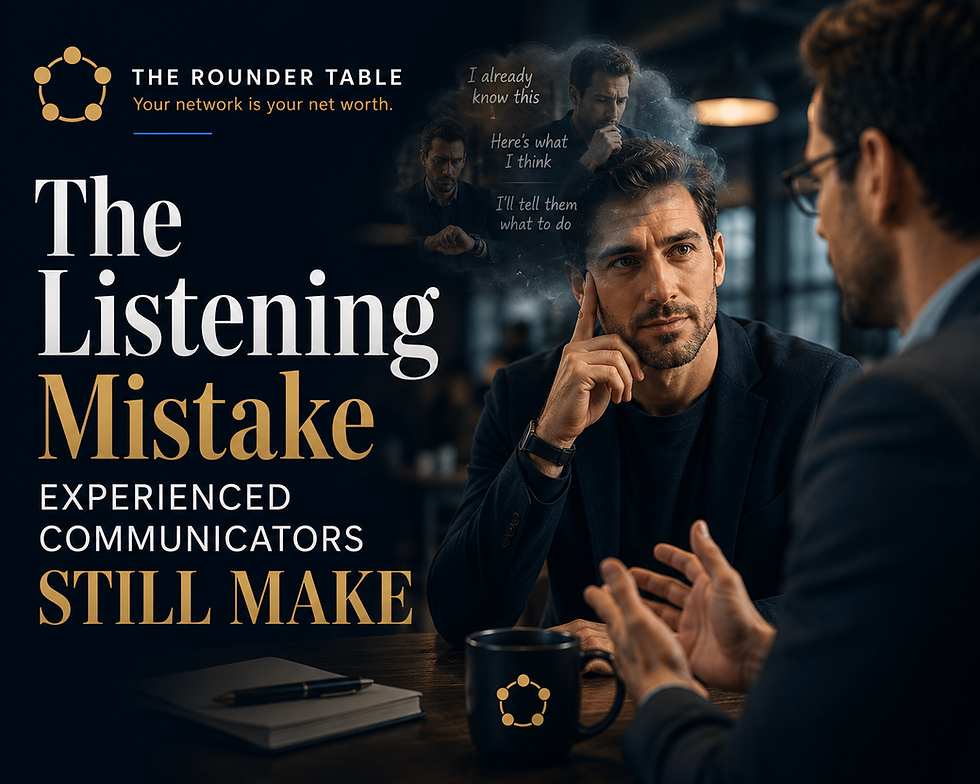
Effective communication is a skill many experienced leaders strive to master. Yet even seasoned professionals often struggle with truly active listening — not just hearing words but fully understanding and responding in a way that fosters real connection.
Eye contact, nodding, paraphrasing, and open-ended questions get most of the attention in communication advice. But there's a subtler barrier that gets far less airtime: internal cognitive noise — the preconceived judgments, anticipated responses, and emotional reactions that quietly interfere with listening. These habits happen so fast that even skilled communicators may not notice how much they disrupt real comprehension. The result is partial attention and a weaker connection between speaker and listener.
Traditional techniques focus on external behavior — nodding, summarizing, asking questions. These improve the appearance of listening but don't address the distractions underneath. When cognitive noise is high, you can still miss what matters most, even while doing everything "right" on the surface.
A Different Angle: Meta-Awareness
The answer is meta-awareness — noticing your own mental process in real time while listening, so you can catch drift or premature responses and redirect focus back to the speaker. This draws on the same foundation as Jon Kabat-Zinn's mindfulness work, applied to the moment-to-moment act of listening.
How to practice it:
1. Set an intention — your goal is to understand, not respond, immediately.
2. Notice your mental state and pause — catch thoughts like "I know what they'll say," and return focus to their words before responding.
3. Observe emotional reactions — note them without letting them take over.
In Practice
Imagine a colleague presents an idea you strongly disagree with. Instead of mentally drafting a rebuttal, recognize the urge to argue as it arises, label it silently ("preparing response"), and shift attention back to their words and underlying concerns. After they finish, respond with a question or summary to clarify — not to counter.
This mirrors what Marshall Rosenberg's Nonviolent Communication calls separating observation from evaluation. The goal isn't suppressing disagreement — it's making sure you've actually heard the idea before responding to it.
Meta-awareness sharpens understanding, strengthens relationships, and reduces conflict, because people feel genuinely heard, and you respond calmly instead of reactively.
The real shift isn't a new set of behaviors. It's catching the half-second where you stop listening and start reacting — and choosing to come back.
Great leaders aren't the best speakers in the room — they're the ones who catch that half-second and choose to listen instead.
“Your next conversation is the test”
#ActiveListening#LeadershipCommunication#MindfulLeadership


Comments